To coincide with the first public release of The Haunted House Hotel in 25 years, some press outlets have been re-examining the case.
Pressure is mounting to revisit the cult favourite murder of Edward DeWitt, and to posthumously clear the woman convicted of killing him. “Investigative” “reporter” Gordon Loosestaff examines the bizarre case:
In November 1999, Marge Merryweather was arrested for the murder of bellboy Edward DeWitt at a novelty dive called The Haunted House Hotel. Noted busybody and florist Marge was placed in maximum-security prison, where she languished, ultimately hosting a YouTube channel about how to crochet clothes for cats.
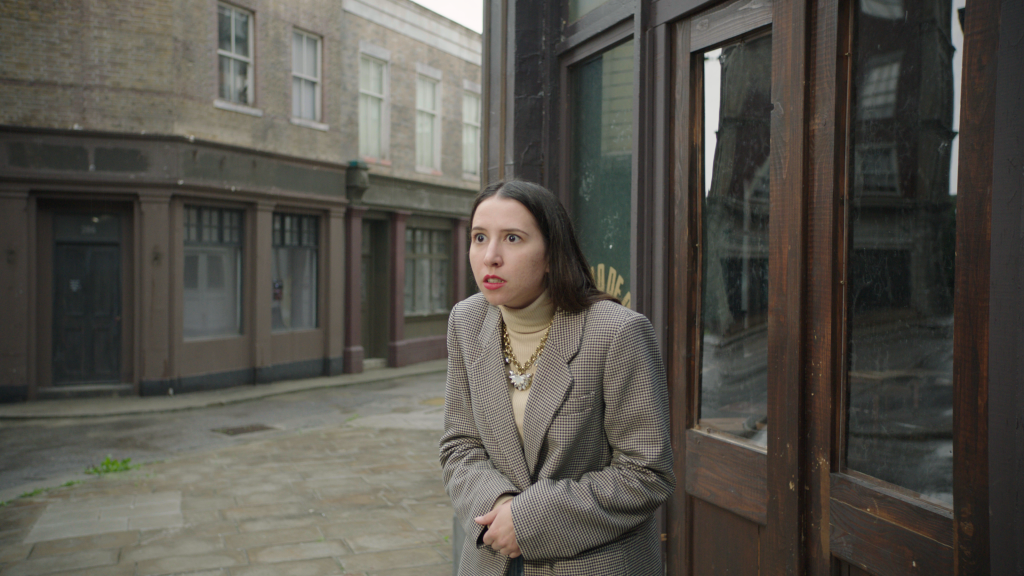
Here’s the headline: she was innocent.
Recap
To tell the full story, we have to go back to the beginning. The Haunted House was an eight-bedroom hotel in the middle of suburbia. Its gimmick was the questionable presence of the undead. Tetch, its owner, was deeply unpopular. He thrived on negative press. When Edward was murdered with poison, Tetch set up a bed next to the chalk outline of the body. It was a hit.
But Edward wasn’t finished. He returned from the dead to make a documentary about his murder. In his one remaining day, he spoke to everybody he knew. For the remaining 23 hours, he came to terms with how unhappy they were to see him back.
Just before the deadline, he discovered he’d been poisoned with a rare kind of flower – the kind Marge grew in her garden.
Edward went back to his grave happy in the knowledge that Marge was behind bars, and her reign of terror as both a murderer and botanist was finally over. But Edward was a bellboy at a tenth-rate hotel. When he died, he left nothing but a chalk outline, a collection of lingerie catalogues and a pet rock called Jock.
And yet Marge was convicted on the evidence of a dead man. Was the documentary a bizarre publicity stunt from the unscrupulous Tetch, or was it really Oscar-bait from a murdered moron? The debate was fierce among paranormal obsessives, but short-lived. The conversation died and, with it, The Haunted House Hotel. Tetch’s reputation never recovered.
Revival
Edward didn’t win his Oscar. The documentary was forgotten for twenty years. It was rediscovered by Jacob Reed, a suspicious hoarder who found it on a dusty VHS tape marked SEVEN DAYS. Covid lockdown being what it was, the 47-year-old figured he’d pop it in his VCR. What he saw disturbed him.
“Instead of being visited by a sexy Japanese girl who I could definitely fix given the chance, there was something far more terrifying,” Jacob told me. “Edward’s documentary. He’d got it completely wrong. Marge couldn’t have been the killer. She was an elderly white woman. I mean. It just doesn’t happen, does it?”
Jacob leapt into action.
“I did what any decent person would do – I fired up Facebook.”
That post led to the creation of the Haunted House subreddit, and from there the documentary went viral. Amateur sleuths sat glued to their phones, ruminating over evidence they didn’t have and people they’d never know. A consensus built: Marge Merryweather must be freed.
The evidence with which she was convicted was weak. The flowers used to kill Edward had indeed come from her garden, and she had hated The Haunted House Hotel. But it was a long step from public protests to poison. The case’s judge, 16-year-old work experience girl Valerie Chance, either didn’t notice the massive gap in evidence or simply didn’t care.
Digital petitions calling to free Marge were signed by literally numbers of people and protests were planned but unattended. Smartphone-powered public pressure grew until the prison system was forced to issue a statement: Merryweather was dead. She’d passed peacefully in her sleep at a support group for narcoleptics. She went undiscovered for four days.
Reunion
The Free Merryweather Forces had failed. The remaining members – both gainfully unemployed – decided they had to find the real killer. Their investigations led me to suspect one: the hotel’s owner himself.
I met Tetch in a swanky big city coffee shop, where milk and syrup flow freely, and drinks with foreign-sounding names were prevalent. We were out of our depth. He looked up to read the menu and his hairpiece fell off.
Tetch was thin and manic-looking in the documentary. Now he’s bigger and older, but gives the same impression of a man with a dozen watches under his coat. He’s a known fraudster and, indeed, refused to pay for his coffee after claiming he’d found a bean in it.
“Is this about the murder or the arson?” he asked when I tracked him down. When I told him it was about Edward, he seemed relieved and agreed to his first interview in 25 years.
”The documentary made me look like a creep,” he said, assuring me he’d waited “four or five hours” before monetising his bell boy’s murder. “I agreed to it so I didn’t have to pay Edward’s family compensation. Then I lost the Haunted House, there’s all the suspicion online – it got out of hand. It’s hard to sneak an honest penny when people are watching your every move.”
The other important character in Edward’s film was Evie, his unrequited crush and Tetch’s daughter. She was the one who pointed Edward towards Marge with a final, secret clue, recorded on a video camera she’d stolen. What became of her?
“She went to Slovakia or Slovenia or one of those places,” Tetch told me. Extensive research involving checking her LinkedIn revealed Evie works just a few minutes down the road from the coffee shop, at an Ikea.
Resistance
At first she didn’t remember Edward. Even when I described the murder in detail, she kept trying to sell me batteries. Finally, she agreed to meet me in the lower section of a bunk bed in the children’s department. She told me, unprompted, that she didn’t live there.
“Don’t tell people I do,” she said. “Not even as a joke.”
Evie is an interesting woman to interview. She has the look of a cat playing with a mouse. One time she stole my pen. Being the serious journalist that I am, I allowed her to keep it.
“Edward? That was his name?” She asked this multiple times. “The Haunted House was my father’s hotel. How am I supposed to remember every single body that came through the place?”
But when Edward’s face appears on my Samsung Galaxy A5, I see a flicker of recognition in her eyes. She may pretend not to know his name, but she clearly cared.
Revenge
“The days after Edmund died were beautiful. Marge was gone, the protests stopped. The hotel was filled every night. Then the documentary came out. There were a lot of… difficult questions.”
What kind of questions?
“The usual things. Why did you kill him? Who else have you killed? So easy to say the wrong thing. Then Marge was locked up, so I must have said the right things.”
When I’d asked Tetch about Marge, he’d been dismissive.
“She wanted me physically,” he said. “It’s fine. She’s only human.”
Evie had different feelings about her one-time neighbour.
“She wouldn’t leave us alone. And she wasn’t the only one. Do you know Edwin wasn’t even employed at the Haunted House? He worked for tips, and he was terrible. If he wasn’t killed, he’d have starved to death. He hung around for all the wrong reasons.”
“So his murder killed two birds with one stone?”
She seemed surprised by the question – a crack in the façade of a woman always four steps ahead. She smiled.
“Your words, not mine.”
Remembrance
And with that, the interview is over. Four hours of being trapped in Lighting later, I emerged from that Ikea with six packs of batteries, an end table, a cordless drill, a bowl of vegan meatballs and more questions than answers.
I filled my 2003 Vauxhall Astra with more shame than usual.
Two and a half decades ago, a murder at the Haunted House Hotel changed the course of history. If not actually, then at least for Marge Merryweather. She spent the rest of her days professing her innocence. Amateur sleuths without training or expertise have finally caught up with her tragic story, and are furious, frightened, and all too often drunk.
Is this just another classic tale of a ghost returning from the dead to make a documentary? Or is there something more unusual and sinister at hand?
Every effort was made to contact Edward DeWitt for this article, though he was too dead to contribute. Two days after our interview, Evie disappeared. She was last seen in Kitchens.